
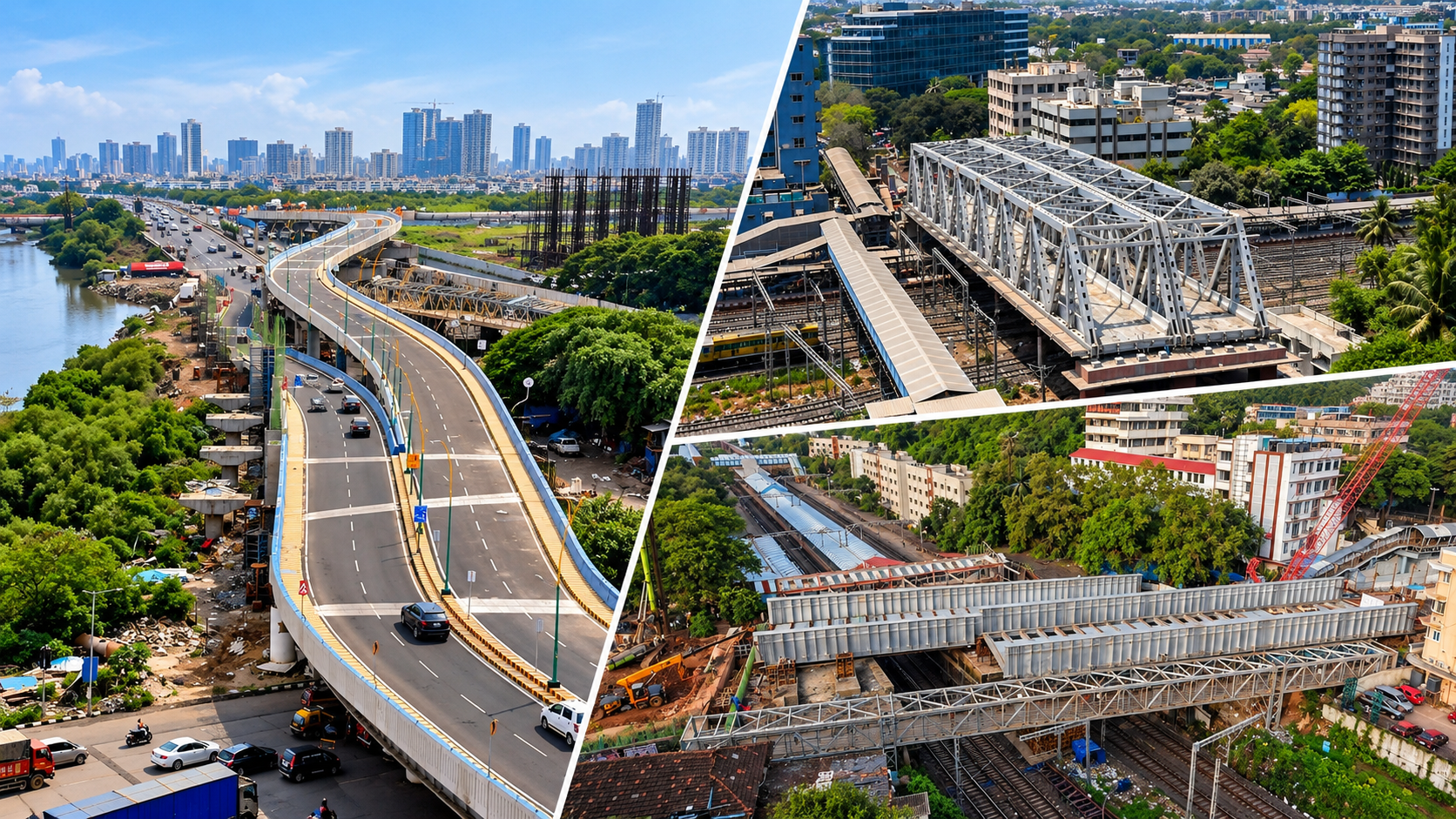
Mumbai is preparing for a significant improvement in road connectivity, with three important infrastructure projects—the Sion Railway Overbridge, Vidyavihar East-West Bridge and Goregaon–Mulund Link Road (GMLR) connector—nearing their public opening. These projects are expected to improve east-west connectivity, ease pressure on existing roads and make daily commuting more convenient for thousands of motorists.
The Brihanmumbai Municipal Corporation (BMC) has indicated that construction work on the three structures is complete or in its final stages. However, their formal inauguration and opening to regular traffic have been subject to scheduling and final administrative arrangements.
Reports published between 15 and 18 October 2026 indicated that the bridges could open together, although the authorities had not confirmed a final public-access date for all three projects.
For Mumbai’s real estate market, the developments are particularly relevant because improved road infrastructure can influence neighbourhood accessibility, commuting convenience and the long-term attractiveness of residential and commercial locations.
1. Sion Railway Overbridge: A Critical East-West Connection Returns

The Sion Railway Overbridge is one of Mumbai’s most important local road links. Connecting neighbourhoods on either side of the railway corridor, the bridge has historically supported movement between Sion, Dharavi, Kurla and surrounding areas.
The old structure, originally built in 1912, was closed for reconstruction after concerns emerged about its structural condition. A 2019 structural audit had identified safety issues, prompting the decision to replace the ageing bridge.
Its closure caused considerable inconvenience to motorists, residents, businesses and daily commuters, many of whom had to rely on alternative routes.
Key Features of the Reconstructed Sion Bridge
According to reports on the project, the replacement bridge incorporates several improvements:
- Project cost: Approximately ₹60 crore.
- Bridge length: Approximately 61 metres, compared with 40 metres previously.
- Road capacity: Four vehicular lanes instead of the earlier two.
- Pedestrian facilities: A dedicated footpath connecting commuters to Sion railway station.
- Additional connectivity: An underpass designed to facilitate pedestrian and vehicular movement.
The project is being implemented through coordination between BMC and Central Railway.
Why the Sion Bridge Matters
Sion occupies a strategically important location within Mumbai’s road network. The area connects several densely populated residential and commercial neighbourhoods and serves traffic moving between central Mumbai and the eastern suburbs.
During reconstruction, commuters travelling between Sion, Dharavi, Kurla and nearby areas experienced diversions and additional travel pressure.
Once operational, the new four-lane bridge should improve traffic distribution across the corridor. Its wider carriageway may also provide better capacity than the original two-lane structure.
The dedicated pedestrian connection to Sion railway station is another important improvement, particularly for commuters who combine road and suburban railway travel.
Potential Real Estate Impact
Improved connectivity could benefit residential and commercial locations around Sion, Dharavi, Chunabhatti and Kurla.
These areas already have established railway and road access, but traffic congestion remains an important consideration for buyers, tenants and businesses.
The rebuilt bridge may improve local accessibility and reduce the inconvenience associated with the earlier closure. However, its impact on property prices will depend on broader factors, including housing supply, redevelopment activity, demand and actual traffic conditions after reopening.
2. Vidyavihar East-West Bridge: A New Link Across the Railway Corridor

The Vidyavihar East-West Bridge is another major connectivity project intended to improve movement between neighbourhoods separated by Mumbai’s suburban railway tracks.
The bridge connects Ramchandra Chemburkar Marg on the eastern side of Vidyavihar railway station with Lal Bahadur Shastri Marg on the western side, creating an additional road connection in the Ghatkopar–Vidyavihar area.
The project is particularly important because railway lines often restrict direct east-west movement across Mumbai. Where crossings are limited, motorists must travel longer distances to reach nearby destinations.
Vidyavihar Bridge: Project Details
Total bridge length 650 m
Vehicle lanes 2
Railway crossing section 100 m
Eastern approach 220 m
Western approach 330 m
The project also includes associated railway-station improvements, such as pedestrian access connections, ticket-booking facilities, staircases and station-related infrastructure.
How Will the Vidyavihar Bridge Improve Connectivity?
The bridge is expected to provide motorists with a more direct connection between the eastern and western sides of Vidyavihar.
Its potential benefits include reducing dependence on existing railway crossings, distributing local traffic across more routes and improving accessibility between surrounding residential and commercial areas.
For commuters, the most important benefit will be the availability of another crossing over the railway corridor.
Implications for Vidyavihar and Ghatkopar Real Estate
Vidyavihar and Ghatkopar are established residential markets with access to suburban rail services, educational institutions, commercial establishments and arterial roads.
Improved east-west connectivity could make local travel more convenient for residents and businesses operating on opposite sides of the railway line.
The bridge may also strengthen access to neighbourhood amenities and reduce the need for circuitous road journeys.
Nevertheless, it would be premature to attribute any specific increase in property values to the bridge before its operational traffic impact is measured.
Latest Opening Update
Reports indicated that the Vidyavihar bridge was tentatively scheduled for inauguration on 18 October 2026. However, a proposed inauguration date should not be treated as confirmation that unrestricted public traffic has begun.
The final opening status should be checked against a subsequent BMC or traffic-police announcement.
3. Goregaon Connector: A Major Addition to the Goregaon–Mulund Link Road Project

The third major project is the elevated connector between Dindoshi Court and Film City in Goregaon, developed as part of the broader Goregaon–Mulund Link Road (GMLR) initiative.
The GMLR is one of Mumbai’s important planned east-west transport corridors, intended to improve connectivity between the western and eastern suburbs.
Mumbai’s existing road network places considerable pressure on major east-west corridors, particularly during peak commuting hours. The GMLR project aims to provide an additional route across the city and improve access between major residential and employment centres.
Key Details of the Goregaon Connector
The Dindoshi Court–Film City flyover measures approximately 1.26 kilometres.
Reports published on 15 October 2026 indicated that the flyover had been completed and handed over by the contractor ahead of the September deadline. However, it was awaiting its formal public opening.
This connector forms part of the larger GMLR development and should not be confused with completion of the entire Goregaon–Mulund corridor.
Why Is the Goregaon Connector Important?
Goregaon has evolved into a major residential, commercial and employment destination within Mumbai’s western suburbs.
The locality accommodates residential towers, business parks, entertainment-related establishments and important transport links.
Road connectivity around Dindoshi, Film City and the surrounding neighbourhoods is therefore important for daily commuters.
The new connector is expected to improve local traffic circulation and provide additional capacity within the developing GMLR network.
Once the wider corridor is completed, its full connectivity benefits could extend beyond Goregaon to other parts of Mumbai.
Potential Impact on Goregaon Real Estate
Infrastructure improvements can influence how homebuyers and businesses evaluate a location.
For Goregaon, improved road access could support the attractiveness of neighbourhoods around Dindoshi, Film City and nearby residential developments.
Commercial establishments may also benefit from improved access for employees, customers and service providers.
However, the opening of the 1.26-km connector alone does not mean that motorists can use the entire GMLR route to travel directly between Goregaon and Mulund.
That broader benefit depends on completion and commissioning of the remaining project components.
Mumbai’s Three Bridge Projects: Key Comparison
| Project | Key specification | Expected benefit |
|---|---|---|
| Sion Railway Overbridge | 61 metres, four lanes | Restores an important east-west crossing |
| Vidyavihar East-West Bridge | 650 metres, two lanes | Improves connectivity across railway tracks |
| Goregaon GMLR Connector | 1.26-km flyover | Strengthens Goregaon’s road network |
Why Have the Openings Been Delayed?
Despite substantial completion of construction work, the three projects have attracted attention because of delays in making them accessible to the public.
According to reports published by Mid-Day and The Times of India, civic officials indicated that the bridges were expected to be inaugurated together, subject to the availability of senior state leaders.
An earlier proposed inauguration on 14 October did not take place. Officials subsequently considered revised arrangements.
The delay prompted criticism from political representatives and members of the public.
Shiv Sena (UBT) MLA Aaditya Thackeray publicly urged the state government to open the Sion bridge without waiting for a formal VIP inauguration.
The debate highlights an important issue in public infrastructure delivery: the distinction between completing construction and making a project available for public use.
Even when major civil works are complete, public opening may still depend on final safety checks, traffic arrangements and administrative approvals.
How Could These Projects Influence Mumbai’s Real Estate Market?
The three bridges serve different parts of Mumbai, but they share an important characteristic: each addresses a connectivity gap within an established urban area.
Better Neighbourhood Accessibility
Improved road connectivity can make residential neighbourhoods more convenient for people who commute regularly.
Additional crossings and connectors can also improve access to schools, hospitals, railway stations and commercial establishments.
Stronger Commercial Connectivity
Businesses depend on efficient transport networks for employee movement, customer access and deliveries.
Better road connectivity may strengthen the operational attractiveness of commercial locations, particularly where congestion has historically been a concern.
Support for Redevelopment Activity
Mumbai is undergoing substantial redevelopment across several established neighbourhoods.
Transport infrastructure is an important consideration when evaluating the capacity of these areas to accommodate additional residents and commercial activity.
Improved roads can support redevelopment, although they must be accompanied by adequate public transport, utilities and other civic infrastructure.
Property Market Implications
The bridges could improve the long-term appeal of certain locations, but their impact on property prices cannot be quantified from construction completion alone.
Actual market effects will depend on traffic performance, travel-time improvements, development activity and local supply-demand conditions.
Which Mumbai Locations Could Benefit?
The surrounding markets most likely to experience improved local accessibility include Sion and Dharavi, Vidyavihar and Ghatkopar, and Goregaon East and Dindoshi.
These are potential connectivity benefits, not forecasts of property-price appreciation.
When Will Mumbai’s Three Bridges Open?
As of the latest reports reviewed for 19 October 2026, the projects were ready or nearing completion, but I could not independently confirm that all three had opened for regular public traffic.
The Vidyavihar bridge had a tentative inauguration date of 18 October, while officials had indicated that the other structures could also open around the same period.
Motorists should rely on official BMC and Mumbai Traffic Police announcements before planning journeys around the new routes.
Conclusion
The Sion Railway Overbridge, Vidyavihar East-West Bridge and Goregaon GMLR connector represent three important additions to Mumbai’s road infrastructure.
Each project addresses a different connectivity challenge: restoring a critical crossing in Sion, connecting the two sides of Vidyavihar and improving road circulation around Goregaon.
Their opening could make everyday travel more convenient while supporting the accessibility of surrounding residential and commercial neighbourhoods.
For Mumbai’s real estate market, the developments reinforce the importance of transport infrastructure in shaping neighbourhood connectivity and long-term urban growth.
The immediate priority, however, remains bringing the completed infrastructure into public use safely and confirming the official opening dates.
Stay informed with IndexTap for the latest updates on Mumbai’s infrastructure and real estate developments.