
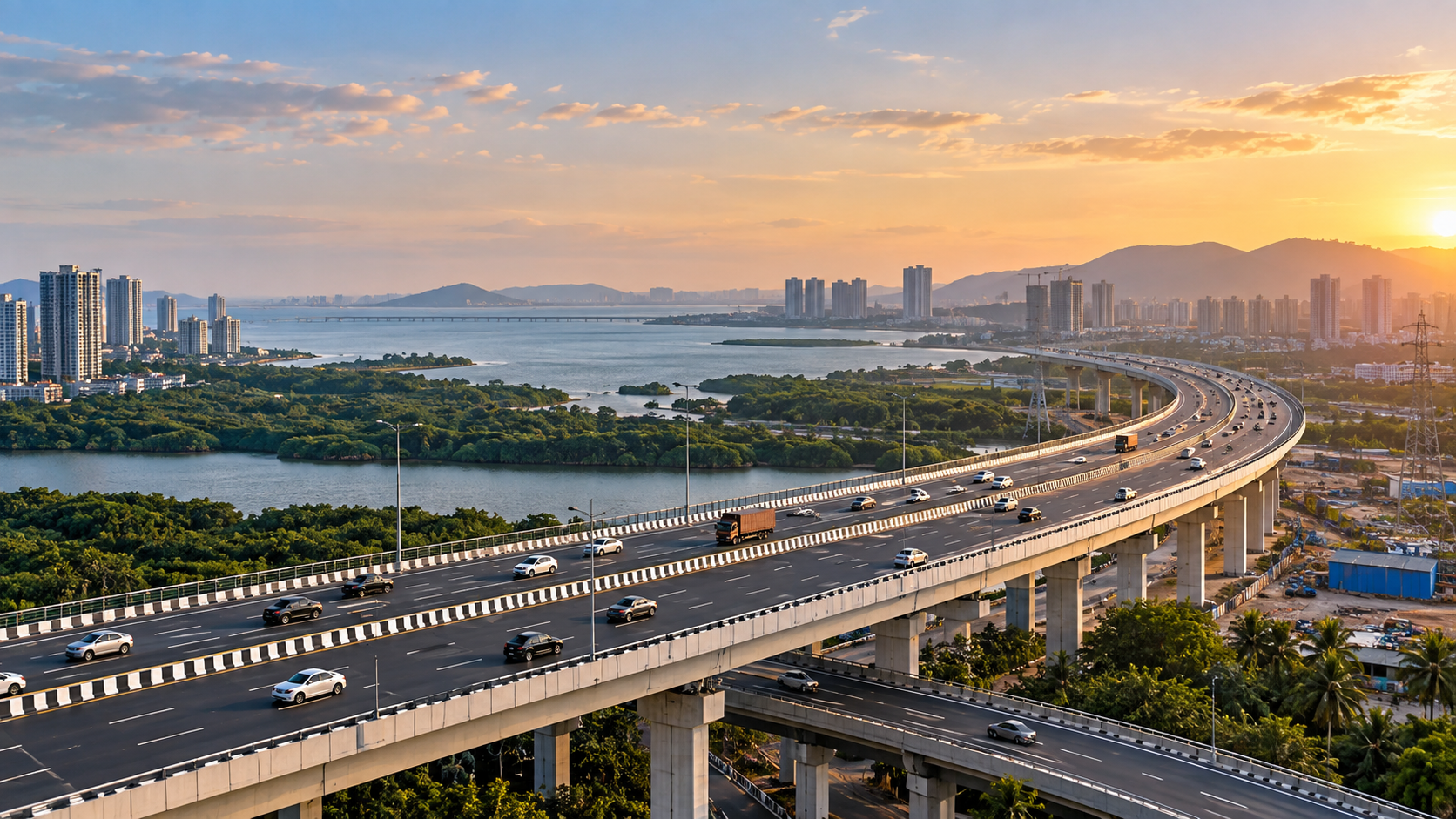
Mumbai’s proposed ring road network is expected to expand beyond the city, with the Mumbai Metropolitan Region Development Authority (MMRDA) developing two new routes totaling approximately 307 kilometers. The move will increase the proposed ring road network from seven to nine corridors, extending connection to Thane, Navi Mumbai, and the northern suburbs.
The projected network will not include the construction of 307 kilometers of fully new roadways. Instead, MMRDA intends to connect existing roads to infrastructure that is already under construction or being planned. The goal is to develop larger, continuous loops within the Mumbai Metropolitan Region (MMR).
The eighth ring road will cover around 197 kilometers, while the ninth ring road will cover nearly 110 kilometers. Both proposed ring routes are designed as access-controlled corridors with a maximum speed of 80 kmph.The MMRDA expects both routes to be completely operational in 2029.
The eighth ring road will connect Thane and Navi Mumbai.
The proposed eighth ring road will form a loop that connects Sewri, Thane, and Navi Mumbai. The route will begin at Sewri, near the Mumbai end of the Mumbai Trans Harbor Link (MTHL), and continue through the Eastern Freeway to Thane.
From Thane, it will take the Anand Nagar-Saket elevated road to Navi Mumbai. Before arriving in Chirle, the road will connect with the Mumbai-Vadodara Expressway and NH-4B. From Chirle, the route will return to Sewri via the MTHL, completing the loop.
The new route is intended to increase communication between Thane, Navi Mumbai, and Bhiwandi. It will also improve access to the JNPT area and other key development and freight hubs.
The ninth ring road will create a loop between Mumbai and Thane.
The ninth ring road will have a different alignment and encompass around 110 kilometers. It will begin at Nariman Point and run north along Mumbai’s coastal road network to Borivali.
The route will leverage important connections such as the Bandra-Worli Sea Link, Versova-Bandra Sea Link, and the northern coastal road. From Borivali, it will travel to Thane via the proposed Thane-Borivali Twin Tunnel.
The route will then go through Thane Coastal Road 1 and the Anand Nagar-Saket elevated road before connecting to the Eastern Freeway extension and the present Eastern Freeway. The projected Orange Gate tunnel will give a connection back to Nariman Point.
Ring road network to connect multiple projects.
The extended network would include infrastructure built by many agencies, including MMRDA, the Brihanmumbai Municipal Corporation (BMC), the Maharashtra State Road Development Corporation (MSRDC), and the National Highways Authority of India.
Several projects from the previous seven-ring plan will also become part of the larger network. These include the Sewri-Worli Connector, Orange Gate Tunnel, Goregaon-Mulund Link Road, and Thane-Borivali Twin Tunnel, as well as existing corridors like the Jogeshwari-Vikhroli Link Road and Santacruz-Chembur Link Road.
New routes aim to ease long-distance traffic.
The overall goal of the ring road network is to give motorists with alternative routes around Mumbai and the MMR. This could help to redirect long-distance traffic away from congested interior routes and spread vehicle flow across various corridors.
Once the necessary linkages are finished, the ninth ring road will form a large circle that will connect South Mumbai, the western suburbs, Borivali, Thane, and the eastern districts of Mumbai.
Stay informed with IndexTap for the latest updates on Mumbai’s infrastructure and real estate developments.